ABC’s, RYT’s and HEY’s
Heidi Nechtman | AUG 31, 2023
yoga for all
chair yoga
healing yoga
yoga certifications
healing emphasis yoga
yoga for grief
ABC’s, RYT’s and HEY’s
Heidi Nechtman | AUG 31, 2023
ABC’s, RYT’s and HEY's
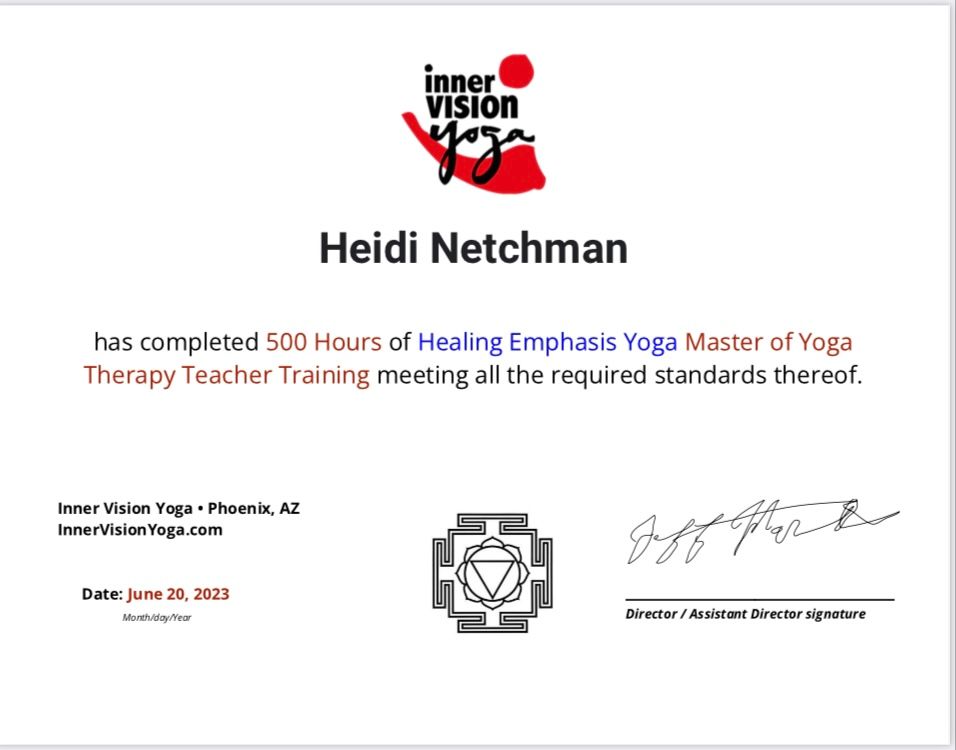
I recently received my 500-hour Master Yoga Certification in Healing Emphasis Yoga (HEY) and shared my excitement and relief through social media. I have received some questions about what the different certifications mean and why there are certifications. These are such GOOD questions. When you are looking for a class and yoga teacher, sometimes it is hard to make sense of all of the different acronyms and you may wonder whether any of that helps you to decide which teacher is best for YOU.
Yoga Alliance Certification
Many of the acronyms relate to the Yoga Alliance, which is a non-profit organization that represents the yoga community worldwide. They provide continuing education and support for yoga teachers, set ethics and code of conduct, and manage accreditation of yoga schools and their programs that qualify for Yoga Alliance certification.
If your yoga instructor has a 200-hour yoga certification (RYT 200), that is an indication that they were trained in a program that is accredited by the Yoga Alliance. I will briefly describe some of the requirements below. They may also be a RYT 300 or a RYT 500 which means they have additional training. If they are an E-RYT, then they have taught a certain number of hours. E is for experienced.
What is the difference between a 200-hour certification and a 500-hour certification?
A 200 hour Yoga Teacher Training (YTT) is the initial training that guides the yoga teacher trainee to teach the general adult population. The course is at least 200 hours of in-person or online training, observation and practicum. According to the accreditation guidelines, the training should cover yoga techniques, teaching methodology, anatomy/physiology, and yoga philosophy, with about 50% of the time spent on yoga techniques.
A 300 or 500 hour YTT will encompass the same areas of learning, but may focus on specific populations or move more deeply into a certain type or aspect of yoga.
Are These Certifications Required in Order to Teach?
No!
There are some instructors that have grown up in a specific tradition, or studied yoga in a more traditional way, through family or their lifetime teacher.
Some teachers may have taken the YTT trainings accredited by Yoga Alliance, but do not feel that it is necessary to be a member of the organization.
Others may not feel that Yoga Alliance represents all of the yoga community and therefore choose not to become or remain a member.
For many, the use of certification acronyms is related to the hiring process. When hiring a yoga teacher, employers or studios look for a standard certification and that almost always is through Yoga Alliance. So you very often see teachers use these acronyms as a way to communicate their experience and knowledge.
Yoga Alliance provides some standardization, but you must remember that yoga is a thousands of years old practice that involves deep knowledge and tradition. All of these ABC’s and RYT’s are a very recent (and Western) development.
Should You Pay Attention to These Acronyms When Selecting a Teacher?
The certifications are one way for you to understand how your teacher has been prepared to teach. However, in absence of those acronyms, you can look at their training, years of teaching and background.
Once you feel comfortable that they have a solid foundation in what they are teaching, then you should ask yourself:
1. Do I feel SAFE in their class?
2. Do I like their style of COMMUNICATION?
3. Do I feel CARED for?
4. Do their classes help me find the FEELING that I am looking for (stillness, strength, connection, etc).
You should be able to ask questions (within the scope of yoga…we are NOT medical or mental health professionals).
You should want to go to class. After all, the hardest part of class is getting there.
Wait! What about the HEY acronym?
HEY is the acronym for the specific 500-hour training that I was a part of. It was a 3-year program that focused on many healing aspects of yoga. It is designed for the participants to experience their own healing as they learn about the various modalities, styles and concepts. Their experience allows them then to better guide others to find their own “healing feeling” through yoga.
We learned modalities such as yin yoga, restorative, yoga nidra, and trauma releasing exercises (TRE). The training incorporated concepts of energetic anatomy, felt sense, somatic movement and a therapeutic view of asana. We explored how subconscious habits and belief systems manifest in the physical body. Each student had the opportunity for transformation through their Fear to Clear training. We learned how to work with specific issues such as senior populations, scoliosis, etc.
For me, the experience was tremendous. Only 3 weeks after I began the training, I entered the worst period I hope I will ever experience in my life. I spent most of this training working through my own grief.
These are just some of the things that I learned from my personal healing experience:
1. Stillness is powerful, but not always accessible. Knowing how and when to achieve stillness may be a lifelong practice for me.
Some people need stillness. Stillness allows them to release tension, emotion, or reach deeply held feelings. If those feelings are very strong, stillness may be a challenge. We need to allow ourselves to move in and out of stillness.
2. Movement of the body and energy within the body is often needed before we can verbalize our feelings.
Some people need movement. Maybe they need specific kinds of movement to address a physical issue. Perhaps movement allows them to process an emotion or stress. We need to find the right movement for each moment.
When our feeling are very strong, sometimes movement is more accessible than talking or writing about our feelings. We need to allow ourselves to just feel sometimes.
3. Awareness helps you to know what you need in the moment, stillness or movement.
4. Sometimes, stories can be told through posture. Emotions, injuries, attitudes toward life are all carried in our posture. Reading those can help to figure out what we need, as well.
I hope that this answers some of those questions about acronyms and the certification process. If you ever have questions about these topics or about the HEY program, feel free to ask at perfectlyimperfectyoga1@gmail.com I love to share this knowledge and experience.
Written by: Heidi Nechtman, E-RYT 200, RYT 500
Date: August, 2023
Heidi Nechtman | AUG 31, 2023
Share this blog post
 OfferingTree